
Government Backs Leather Training at Thika for Jobs and Industrial Growth
Industry Principal Secretary, Dr. Juma Mukhwana has affirmed the Government’s commitment in enhancing the growth of the leather industry through supporting the training to boost jobs and industrial growth
Through revamping of technologies in Technical Vocational Education and Training (TVET) for training of courses on leather production and processing, PS Mukhwana said this would ensure industry demanded skills and manpower further transforming the sector and creating employment.
Dr. Mukhwana noted that while Kenya was well endowed with resources such as a cattle population of over 80 million, placing it 11th globally, it still lacked sufficient skilled personnel to fully capitalize on these strengths.
Kenya, he said, also benefitted from wide market access through Free Trade Agreements that cover leather and its products with major importers. These advantages positioned the country as a global powerhouse in the leather industry.
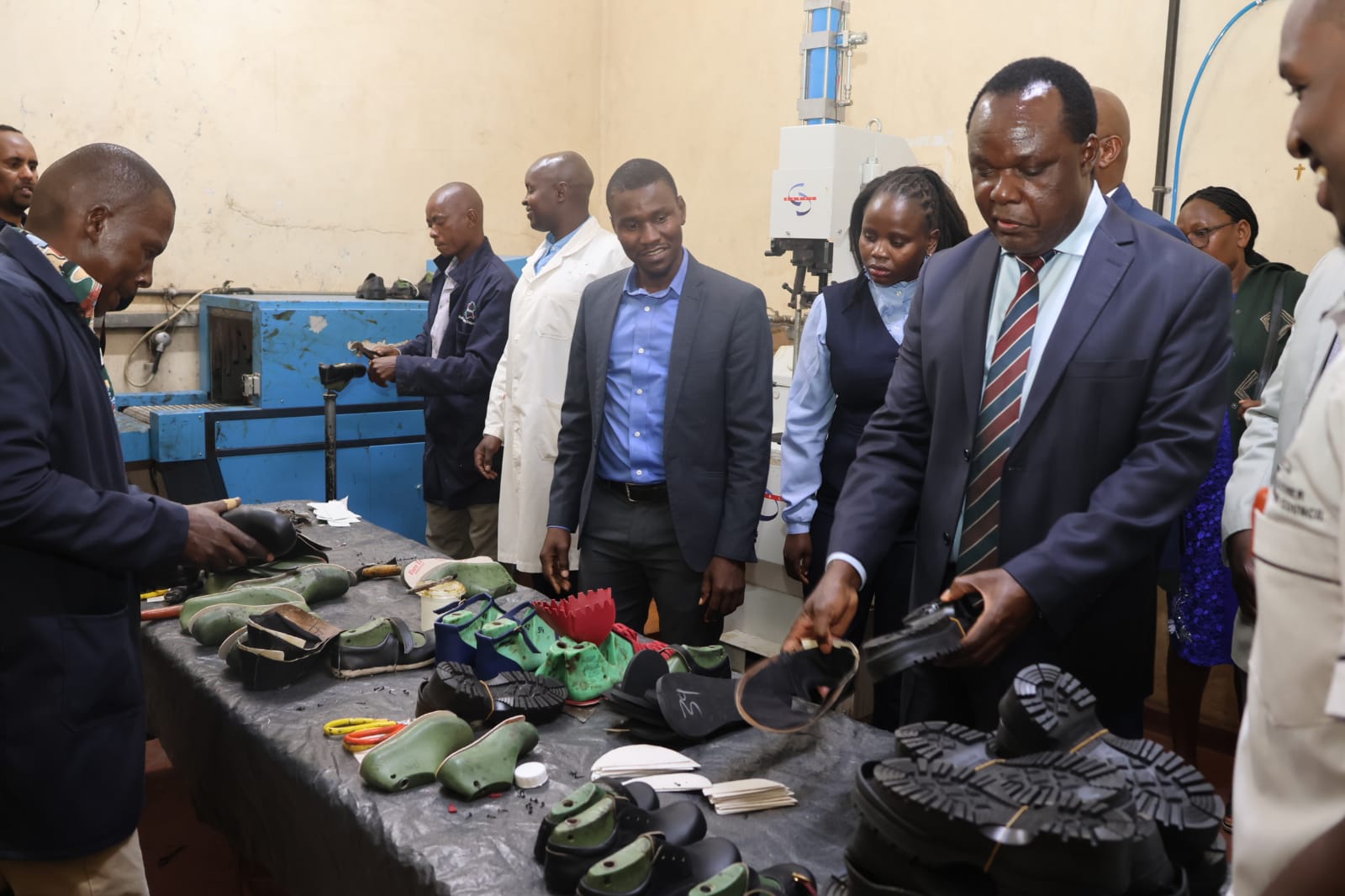
Speaking during a tour of the Training and Production Centre for Shoe Industry (TPCSI), based in Thika, the PS noted that, “In terms of training and capacity building we realize that because this sector has been low, we don’t have all the skills for leather design and production.
To address the skills gap, the PS revealed that the Government is working with the Italian Government to secure a grant to support TPSCI through provision of modern machinery, training programs, digitization of processes, and internship opportunities for trainees.
“KITI is already training people at different levels in leather technology and craft and is offering certificate and even diplomas, TPSCI in Thika is also doing a lot of training in common user facilities such as the one in Kariakor and is also engaging in training”, Dr. Mukhwana noted.
He urged KITI to come up with more ways of ensuring that students got sponsorship to train in the production of leather goods through collaborating with partners such as international donors, the County Governments and sourcing for bursaries from CDF.
PS Mukhwana noted that for the leather industry to grow and also produce commodities that could compete at the international level, training was paramount to ensure that quality and well-designed leather products were being produced.
He also encouraged more students to apply for TVET courses in tanning citing the opportunities being made available as the leather industry continues developing though support from the Government in collaboration with the private sector.
Dr. Mukhwana also noted that there was a lot of potential for the growth of the leather industry saying that the country was producing large quantities of skins and hides that were either being exported or disposed and through training more people this would act as a source of employment.
The PS also called on institutions like the Kenya Industrial Research and Development Institute (KIRDI) and the Kenya Industrial Property Institute (KIPI) to support the sector through training, mentorship, and intellectual property protection for locally made leather products and designs.
Dr. Mukhwana also confirmed that the Kenya Leather Industrial Park in Machakos County will be operational by the end of the year, further anchoring Kenya’s ambitions to become a regional leather hub and providing additional employment opportunities for trained leather professionals.
Accompanying the PS during the visit, Kenya Leather Development Council (KLDC) CEO Dr. Mohammed Noor highlighted the Council’s efforts in supporting TPSCI with upgraded machinery and curriculum review. “We aim to make TPSCI a continental centre of excellence for leather training,” said Dr. Noor.
KLDC is currently seeking partnerships with international organizations such as the United Nations Industrial Development Organization (UNIDO) to expand the TPSCI facility and offer scholarships to tanning students. Dr. Noor noted that the centre is already receiving students from institutions like KITI and universities and is ramping up efforts to attract more.
The CEO also remarked that the facility was receiving students from KITI and other local universities through an exchange programme, adding that the institution was now focusing on attracting more students to the tanning course as a driver for development in the leather industry once they were trained.
Dr. Noor emphasized on the need for more trainers for the facility, saying that they were needed in order to cater for the increasing number of students.
The KLDC CEO added that,” Kenya produces three million hides from large livestock such as cows and camels with 18 million hides and skins coming from smaller livestock such as sheep and goats,” as he highlighted the importance of training more students in tanning as a source of employment and also to aid in environmental conservation through reducing wastage.
TPSCI is involved in the training of short-term courses which go for six weeks and cover the whole process of manufacturing from designing to finishing of leather products. The students are trained on the processing and production of leather products.
TPSCI is also engages in the production of leather goods such as footwear, belts and wallets from the first to the last stage of production using locally sourced materials.
“The first stage involved in the production of leather goods such as shoes is the designing of the product which involves cutting patterns followed by stitchers where the shoes components are assembled then followed by lasting where the shoes are assembled and begin to take shape”, explained Lucy Mumbi, who works at the factory.
Leather crafter Winnifred Ngena explained, “Finishing involves removing glue and thread remnants to ensure the product is polished and market-ready.”
The leather industry in Kenya presents a wide range of investment opportunities — from modern slaughterhouses that ensure high-quality hides, to tanneries producing finished leather for export and local footwear production. The footwear sub-sector alone is worth over $200 million, underlining the value chain’s contribution to GDP and job creation.
This renewed focus on the leather sector aligns with the Government’s Bottom-up Economic Transformation Agenda (BETA), which prioritizes industrialization as a pathway to economic growth and Vision 2030 targets.
As the Government, through its partnerships and training programs, continues to invest in the sector, Kenya is positioning itself as a leading player in the global leather market.